
Occasional observations on the wildflowers of 91011.
At Cherry Canyon, over half the terrain is covered by shrubs. Most of them are flowering shrubs, including some that bear flowers pretty enough to serve as a bouquet or even a corsage. But then there’s the shrub that everyone loves to hate: Poison Oak. The common name is hardly enticing, but neither is the Latin name: Toxicodendron diversilobum basically means a “poisonous tree” whose leaves have “variable shapes.” Nothing in either name would suggest that Poison Oak has flowers (it does!), nor that it produces berries (it does that too!).

The flowers of Poison Oak are clusters of white, five-pointed stars. The center of each star is pale green and appears slightly gelatinous. The stars are sometimes hard to see, though, because the points of the star (= the petals) flex backwards fairly soon in the life of the flower. Nonetheless, it’s common to see bees happily working their way through the dense array of blossoms. Those blossoms, in turn, will produce berries. And the berries will be eaten by birds, including migratory birds.
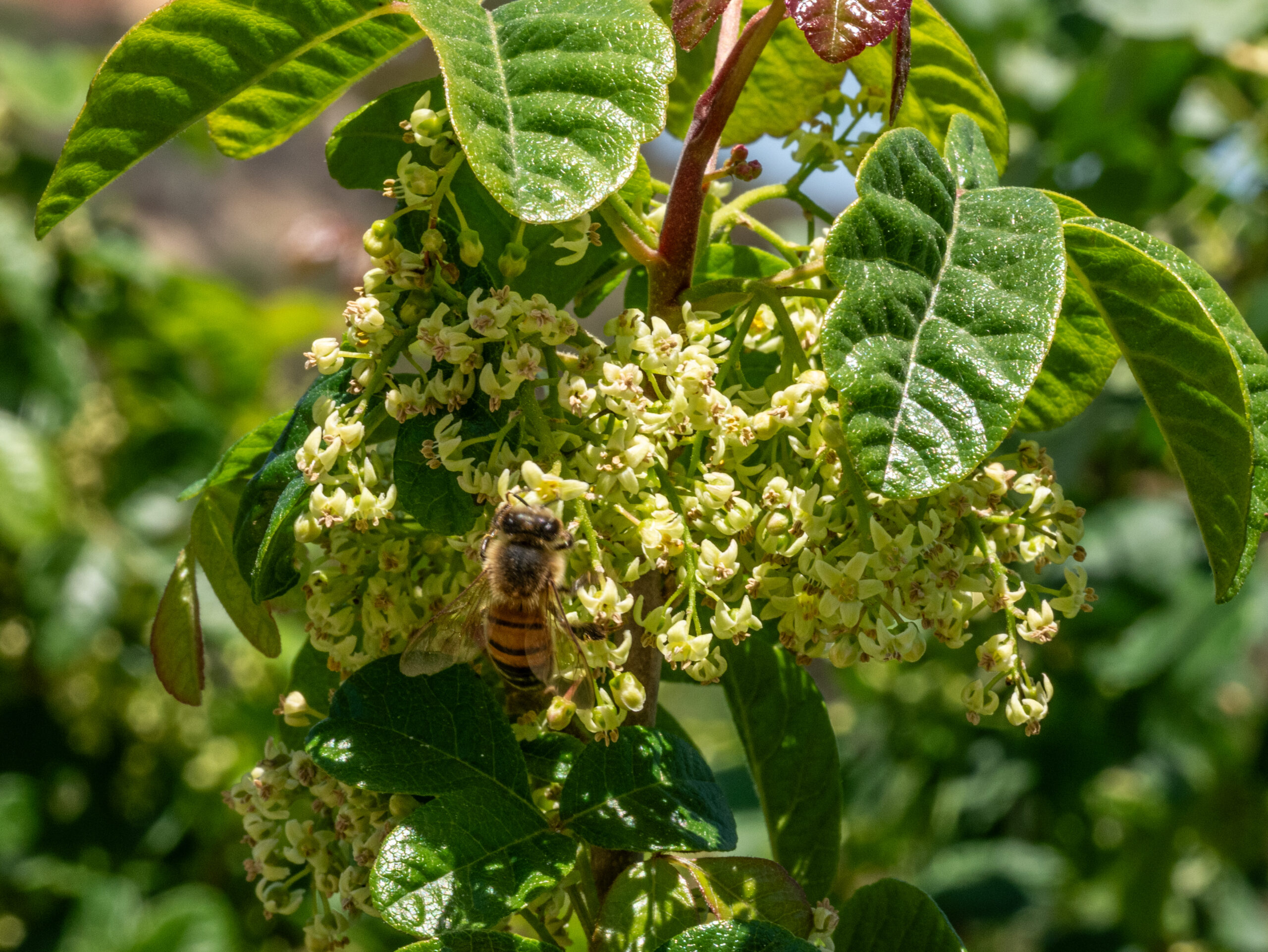
The “poison” in Poison Oak is urushiol, an oily organic compound that can cause exposed skin to develop a nasty blistering rash. That’s a good reason to learn how to recognize this shrub before you get up close and personal. Here’s a couple of hints that not everyone knows.
- First, Poison Oak is deciduous: it loses its leaves in the fall and grows new ones in the spring. When its leaves are new or young, they take on a reddish, extra-oily appearance; you can see one of those red “juicy” leaves in the center of the photo below. And when fall approaches (or in the wake of a heat wave), its leaves are among the very first to turn red — sometimes gloriously bright red! (Though in higher elevations, say, near Mt. Wilson, Poison Oak leaves can turn a mixture of whitish and pale pink in the fall, which is also rather pretty!) In any case, watch for a shrub with at least a few (and maybe quite a few) reddish or reddish-tinged leaves.
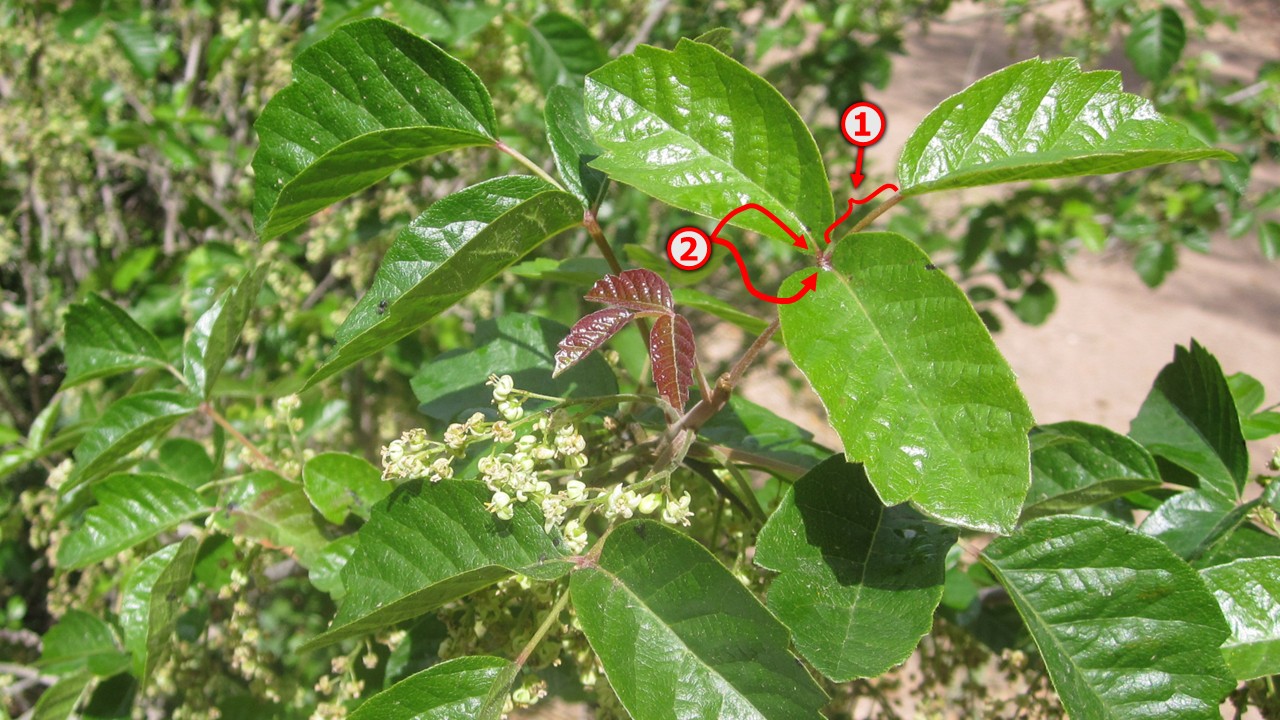
- Second, what about that old “leaves of three, let it be” maxim? Well, it sorta works. But bear in mind that the shape and complexion of Poison Oak leaves can be extremely variable, AND that there are other shrubs that have branches ending in a trio of leaves. (More on those other shrubs in another post!) But here’s the hint: for Poison Oak, two of those three leaves sit right on their twig or branch, but only one — the one on the very end — has a little stem or “petiole” about half an inch long. Look at the photo above: the number (1) points to that little stem, while the number (2) points to the other two leaves, which have no such stem.

Ripening Poison Oak berries, and a garland of heat-stressed red leaves in early June
Where and when to find it. The leaves of Poison Oak appear in mid-winter months; the flowers appear in April. The leaves take on their fall color as early as late July, though sometimes if a branch is damaged, its leaves will turn red from stress regardless of the month. As for where to find Poison Oak, well, expect it everywhere, along almost all of our trails. You should also expect it to blend in and weave itself into other shrubs, like Bush Monkeyflower, gooseberries and currants, or almost any shrub. I’ve seen it sneaking into blackberry bushes! So learn to expect it, learn to recognize and respect it, and — seriously! — don’t pick its flowers to make a corsage, even if she just broke up with you.
- For more about Poison Oak, visit Wikipedia.
- For information about growing Poison Oak in your yard (not joking!), visit Calscape.org.
- For distribution maps, taxonomy, and more photos, visit Calflora.org
- You can also read (or subscribe to) other occasional notes on the wildflowers of 91011.
